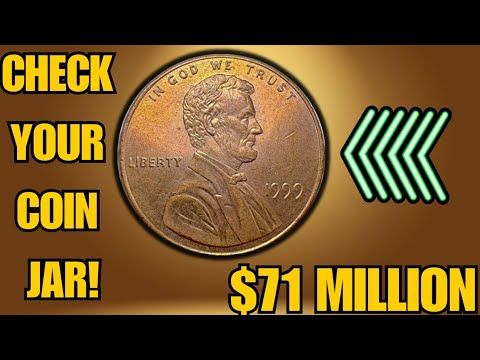
The caption “$71 MILLION” is a sensationalized, hyperbolic claim designed to capture attention—and it certainly works! While a single 1999 Lincoln Cent has not sold for that staggering amount, the image and caption are based on the very real, high-value errors and varieties from that specific year that are worth thousands of dollars. The 1999 cent is one of the most critical modern coins to check, as one tiny, accidental mistake made it a pocket-change fortune.
If you have a 1999 Lincoln Penny, you are hunting for one of three main errors: the highly-prized “Wide AM,” the scarce “Mule” error, or a major doubling anomaly. Here is the breakdown of the treasure to look for:
Secret #1: The Critical Wide AM Variety
This is the most famous and accessible error from 1999, resulting from a major die mix-up at the U.S. Mint. It involves the reverse design, which shows the Lincoln Memorial.
What to Look For (The “Secret”):
-
Locate the Initials: Look at the letters ‘A’ and ‘M’ in the word “AMERICA” on the reverse (the Lincoln Memorial side).
-
Compare Spacing: On a common 1999 penny, the base of the ‘A’ and the base of the ‘M’ are designed to be touching or very close (a “Close AM”).
-
The Rare Find: The highly valuable error pennies—the “Wide AM” variety—have a clear, distinct separation or gap between the lower parts of the ‘A’ and the ‘M’. This happened because a reverse die intended only for Proof coins was mistakenly used to strike circulation pennies.
Value:
The 1999 Wide AM variety is considered rare, with only an estimated 5,000 or fewer known. Uncirculated examples in high grades (MS-67 Red) have sold for over $4,500 at auction. Even circulated examples in lower grades can be worth $100 to $400, making it a fantastic discovery in pocket change.
Secret #2: The Ultra-Rare Die Mule Error
This is the kind of bizarre minting mistake that pushes a coin toward the six-figure mark, although only a handful are known to exist. The term “Mule” refers to a coin struck with two dies that were never meant to be paired together.
What to Look For (The “Secret”):
The 1999 Mule error features a die clash where the obverse (front) of the coin exhibits faint design elements from a different coin’s reverse. One documented case is a coin struck with a cent obverse die and a die from a different denomination, resulting in incredibly faint but visible details from the wrong coin’s design being impressed onto the penny’s surface (a mule die clash).
Value:
These are among the rarest modern minting errors. A famous 1999 Mule die clash error was graded MS-63 and has been reported to command values well over $100,000. If a perfectly struck, high-grade example were to surface, it would be the coin most likely to flirt with the ultimate valuation suggested in the caption.
Secret #3: Doubled Die Varieties
While not as valuable as the Wide AM or the Mule, certain doubled die errors on 1999 cents are also worth a look.
-
Doubled Die Obverse (DDO) and Reverse (DDR): Check the coin’s date, motto (“IN GOD WE TRUST”), and the lettering on the reverse for any clear, distinct doubling of the characters. A Doubled Die Obverse (DDO) from 1999, specifically showing doubling on Lincoln’s ear, can be a valuable variety.
Why the “Seven Figure” Caption?
The $71 Million figure is likely a marketing strategy often used in the world of online coin collecting. It’s likely an inflated reference to the aggregate value of all known rare 1999 pennies, or a direct exaggeration of the most expensive penny ever sold (a 1943 Copper Penny, which is worth millions).
The reality is this: The most valuable 1999 cents are the Wide AM variety and the Mule errors. Finding either is a genuine, significant numismatic treasure hunt that can easily lead to a four- or even five-figure payday.
Your Coin Jar Checklist
-
Pull all 1999 Pennies: Check any coin from this year, regardless of the mint mark (or lack thereof).
-
Inspect the Reverse: Use a magnifying glass to check the ‘A’ and ‘M’ in AMERICA. If there is a clear gap (Wide AM), you have a rare coin!
-
Check for Doubling: Look for clear doubling of the date or lettering on the obverse and reverse.
-
Seek Professional Opinion: If you find a Wide AM or a potential Mule error, you should have it authenticated and graded by a reputable service (like PCGS or NGC) to confirm its value.